

Dream epistemology

The Wrong Instrument
I have been making AI video reconstructions of my dreams lately. The results are surprisingly accurate — the right faces, the right rooms, the right spatial relationships. And yet watching them feels completely wrong in a way I have been trying to articulate.
Then I looked at a still image generated from one of those dreams — a scene from what I call the Salton Sea dream — and something clicked.
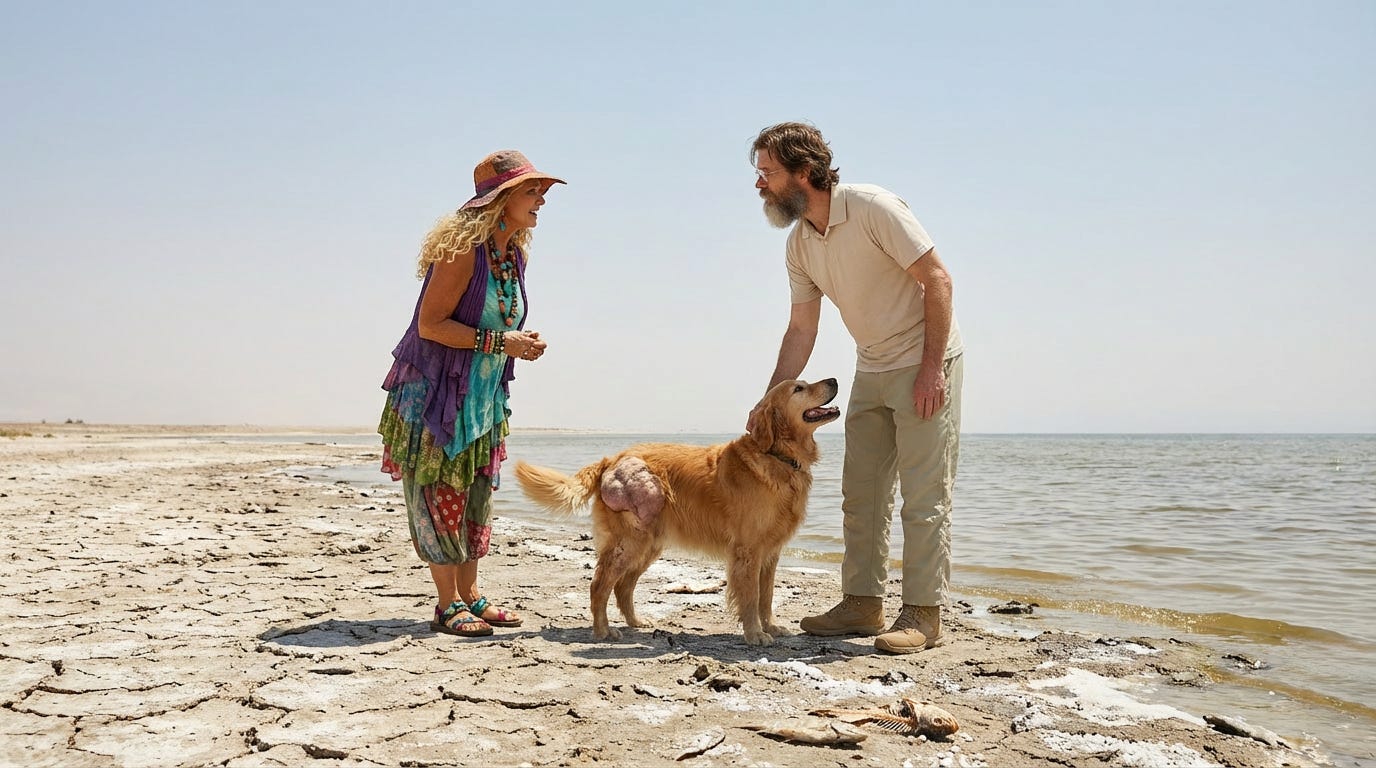
The image shows a bearded man in a cream shirt petting a golden retriever with a large tumor on its haunches. A colorfully dressed woman stands nearby talking to him. Behind them, cracked salt flats meet pale grey-green water. A dead fish lies in the foreground. The man is intentionally modeled on me, convincingly enough that my wife recognized him immediately.
And here is the thing: that is what the dog looked like. That is what I looked like. That is what the woman looked like. The ground, the water, the dead fish — all of it is consistent with what I remember from the dream. By any objective measure this image is an accurate reconstruction.
And yet looking at it feels completely different from the dream. Not wrong exactly. Just a different thing entirely.
I have been trying to identify what the difference is, and I think I can get close to it. The image has a visual sharpness that the dream did not have. Not that the dream was blurry — the elements were very focused. But they were not focused in this way. Similarly the color in the image is clear, high contrast, structured by light falling on surfaces in the way light does in the physical world. We learn to read that — the way light creeps around a curved surface differently than a flat one, revealing shape and structure. When I look at this image I understand it through that learned system of light and surface.
In the dream I also understood what I was seeing. But I was not using that system.
This is actually not so different from the relationship between how I see this image and how an AI perceives it. When a model processes a photograph it identifies the content accurately — dog, woman, cracked earth, water. It knows what is there. But it is not seeing it with eyes. It is not parsing light falling on surfaces. It arrives at the same propositional knowledge through a completely different mechanism. We both know what the image contains. We do not share the experience of seeing it.
That gap — between knowing what is there and experiencing the seeing — is precisely the gap between the dream and its reconstruction.
In dreams, I now believe, what we call vision is not vision. It is a different faculty that produces outputs we describe in visual terms because those are the only terms we have. Words in dreams are not spoken so much as received — arriving complete, without the mechanics of language, without phonemes or parsing. What we call dream sight works the same way. It mimics the qualities of waking sensory experience closely enough that we describe it in sensory terms. But the mechanism is entirely foreign to waking life.
This is why no reconstruction can capture it fully. Not because the tools are inadequate. Because the source and the target are incommensurable. The AI video and the still image are light shone at a different angle through the same cloud. What you see is real and related to the original. It is not the same cross-section.
The image convinced my wife. It is consistent with my memory in every particular I can identify. And looking at it feels like reading a temperature off a thermometer rather than putting my hand in the water.
The number is correct. That is not the same as knowing the cold.
I'd guess that's because our (or mine, at least) dream perspective is usually "zoomed in" and not that "cinematic (all encompassing)". I think comics like panels showing zoomed in things side by side make it more "like it".